Advent Week Two: “Goltraí” Letting Sorrow Become Love

Last week, in the joyful strain — geantraí — we began by welcoming the darkness with a hint of cheerfulness.
This week, we cross the threshold into the second Irish noble strain:
Goltraí — the sorrowful strain
where tears become teachers,
where grief becomes a softener,
where love rises from the places that once felt broken.
In the traditional Advent wreath, the second candle is the candle of Love.
But love is not always warm at first.
Sometimes love requires us to pass through sorrow,
through memory,
through the tender places where we learned to hold ourselves together.
This is the work of Week Two:
letting sorrow soften us enough that love can reach us.
A Personal Story of Grief + Becoming
This story is long but very real, raw, and reverent. I hope you will take the time to read it.
I’ve carried sorrow in my body for as long as I can remember.
Some came from childhood—my parents’ divorce, learning challenges that made school an uphill climb, and the generational wounds that shaped the emotional atmosphere I grew up in.
Some came from the simple human longing to be seen, to be loved, to belong.
As a young girl, I learned to perform my way into being chosen.
Beauty pageants, singing for approval—trying to become the shining version of myself I hoped others would want.
Without realizing it, I was building a persona — a mask meant to keep me safe.
It would take decades to understand that performing is not the same as being.
This past year, in a professional training at the Mind Body Music School to become an Alexander Technique teacher, everything I thought I knew about myself was brought into the light.
Alexander work isn’t really about posture at all.
It’s about becoming aware of the subtle, unhelpful habits we use to meet life — the bracing, the tightening, the holding on — and discovering that a different response is possible.
And it brought me face‑to‑face with the self I had been carrying.
The Breaking-Open Moment
During a summer intensive, we were asked to choose an activity and explore it alone—not to improve it, but to observe ourselves.
Everyone dispersed into separate spaces.
Something about the assignment touched an old emotional wound.
I didn’t just feel overwhelmed.
I felt abandoned.
I couldn’t choose an activity. I felt lost.
So I sat down and wrote in my journal.
Our teacher, Peter, moved quietly from student to student — witnessing each of us in our process.
That is part of what a true teacher does: to witness, to mirror, to guide, to hold space, to be a kind of spiritual friend.

When he reached me, he simply asked:
“Can you trust the chair beneath you?”
Yes.
“Can you trust the ground beneath the chair?”
Yes.
And something opened in me — not because he told me anything, but because an inner truth finally rose up.
A wave of knowing erupted through my body:
“Oh my God…”
It burst out before thinking.
I saw — with shocking clarity — that I had been holding myself up for decades:
bracing against rejection,
holding myself together through perfection,
lifting myself to be pleasing, proving, performing, protecting.
Holding myself in my chest, in my solar plexus, as if my worth depended on it.
And when I saw it…
the holding let go.
My chest dropped.
My body fell into gravity — not collapsing, though it felt like it —
but surrendering.
And paradoxically…
I felt lighter.
It was a revelation I would spend the rest of the year understanding.
It marked the moment the “Nasty P’s”
(Protecting, Pretending, Performing, Proving, Pleasing)
finally cracked —
so the “Nice P’s”
(Presence, Process, Perception, Patience, Prayerfulness)
could begin to take root.
Only later did I realize:
You cannot go up until you have fully gone down.
You cannot receive revelation until you have fully incarnated.
You cannot become until you allow yourself to be held.
Learning to Release, Not Brace
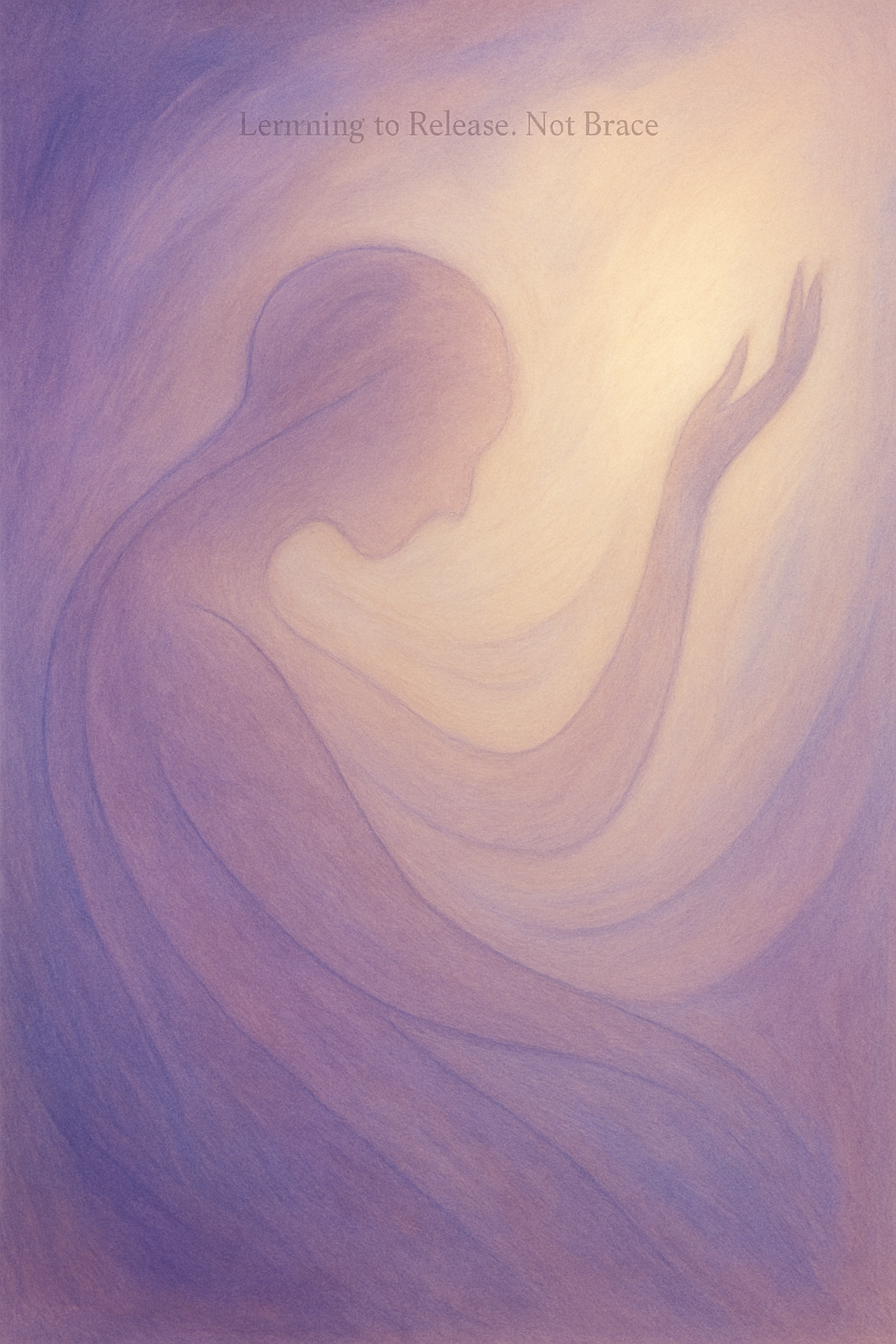
Since that moment, the pattern hasn’t disappeared —
but now I can see it.
Most often, I notice it in my face:
the pulling down when I concentrate,
the tightening around my eyes,
the subtle bracing that says, “Be safe. Do it right.”
It took time to understand that bracing down and holding up
are two expressions of the same survival pattern.
Patterns that once protected me
now keep me from being fully present.
Now, when the pattern appears:
I feel it sooner.
I soften faster.
I release instead of react.
I let gravity take me —
not in collapse,
but in trust.
And trust changes everything.
Trust allows me not to hold.
Trust allows me to be held.
And this, I am learning,
is the condition required for love.
Because we cannot love
when we are bracing for impact.
We cannot receive love
when we are holding our breath.
We cannot offer love
when we are protecting ourselves from life.
Each time I soften rather than tighten,
I return to that summer revelation:
I don’t have to hold myself together to be whole.
Wholeness comes when I stop holding.
The Nourishment of Release
When I release downward,
I am not giving up —
I am allowing myself to be supported
so I can rise in the way nature intended:
whole, upright, unforced, awake.
This release is nourishment.
When I stop holding myself:
the body organizes,
breath deepens,
the nervous system softens,
and the muscles find their natural tone —
not rigid,
not collapsed,
but alive and musical.
I used to think tone was something I created with my voice.
Now I understand:
Tone is the quality of the muscles
when we are neither bracing nor collapsing.
Tone is music running through the body.
When I release into trust,
the body rises on its own —
a rising that is given, not forced.
This is what we practice at A Supple Voice.
Not perfection.
Not performance.
But becoming human enough —
soft enough —
present enough —
to let the voice come through us freely.

A Week Two Reflection for You
This week, I invite you to review your year gently:
Where did sorrow visit you?
Where did you hold yourself together to survive?
What grief is ready to soften?
What old version of yourself is ready to be released?
Let sorrow become softness.
Let softness become love.
🎶 This Week’s Song “Winter Song”
by Sara Bareilles & Ingrid Michaelson
Winter Song is a song shaped by longing —
a question whispered into the quiet of winter:
“Is love alive?”
It doesn’t answer with certainty.
It answers with feeling.
There is a trembling honesty in this song,
a tenderness that echoes the very essence of Week Two —
that love often begins in the softening that sorrow brings.
This song holds the ache of winter
and the hope of what wants to grow in the cold.
It invites you to listen not with your ears alone,
but with the part of you that knows how to receive warmth
even in the middle of a frozen landscape.
When you listen, let the song meet you where you are —
not to fix anything,
not to lift you out of your experience,
but to sit beside you gently in the quiet.
🎤 Optional Karaoke Version
If you feel called to sing with the song — not to “get it right,” but to feel sound moving through your softened, supported body — you may use the karaoke track here:
👉 Karaoke link
Let your voice enter like a whisper of warmth in winter.
Let it be gentle.
Let it be yours.
🎧 A Gentle Listening Practice
You are invited to:
• listen in stillness
• hum softly if you feel moved
• place a hand on your heart
• let the music touch you
• notice what stirs
Not to perform.
Just to receive.
A Blessing for Week Two
May your sorrow soften.
May your grief open gently.
May every tear become a doorway to love.
And may you feel held —
held by earth,
held by truth,
held by the quiet kindness rising within you.